About / Bio
Paula Tove Alderin is a multidisciplinary artist whose work explores the dual forces of becoming and destruction, dwelling in moments of where formation and collapse unfold. Foregrounding rawness and instability, as indeterminate, porous zones of transformation.
Her practice engages with the liminal, the not-yet-formed, through the lenses of philosophy and belief systems. In recent years, she has increasingly engaged with the political dimensions of these concepts. Her work is shown as expanded painting, sculpture, collage, light, and site-specific installations - navigating the boundaries of language, matter, and embodied experience.
Drawing from early experiences shaped by flesh and spirit, rawness and beauty, shame, and other realities than the apparent, her work probes thresholds of space and concept. Her work also draws from resistance against erasure in a world increasingly marked by disembodiment and political urgency.
“What was to go on the canvas was not a picture but an event” (Harold Rosenberg,ARTnews, 1952)
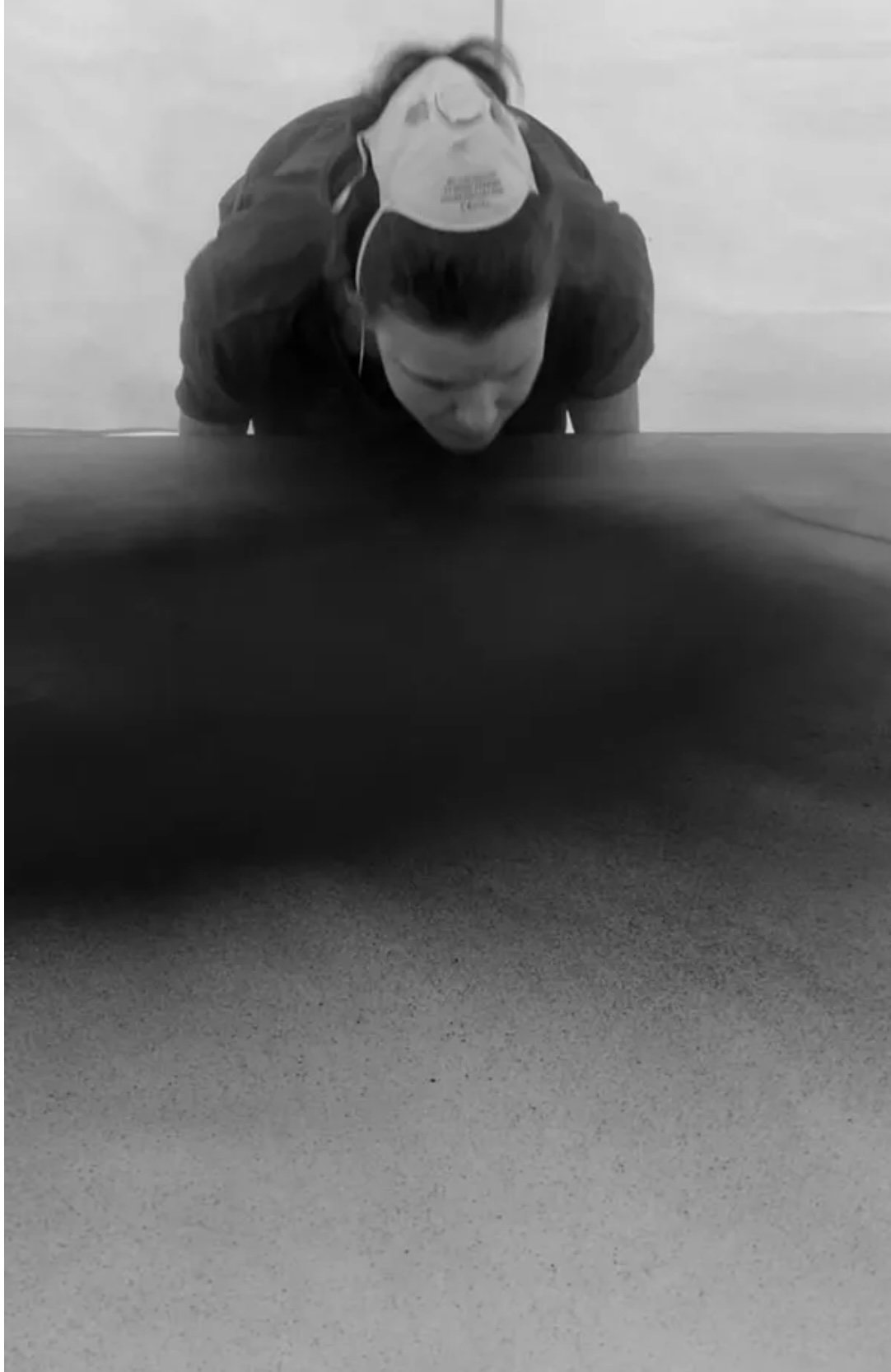
Ritual often serves as aspace for Alderin to evoke presence and hold space for reflection. Through various acts and iterations - blowing, hauling, decaying, surrendering - she explores how body and materiality, as a site of experience and confrontation, can render the formless, incorporeal, and the unimaginable into palpable being. In a mediating act that holds time, connecting the personal and the collective, calling forth memory and the raw potential at the emerging edge of experience. Her actions take form in an interplay between the intelligible and the obscure, the existent and the insistent through personally or culturally charged materials, acting as bearers of their own meaning or as containers of ideas and notions. Her work moves between the poles of reductive restraint and expressive gesture, a tension often thought of as conflict. Yet it is in this in-between zone that she finds the restless space of flux and stillness, presence and absences, proximity and distance. Seeking, to hold both in a state of instability, openness, as she follows what surfaces in the nature of becoming and in the shadow of destruction.
“But what remains after an act has ended? What are the obligations of a witness to an act that is over? These questions are thoroughly theatrical and performative, but they are also intimate and ethical” (Peggy Phelan, Lessons in Blindness, PMLA,
2004).
Weaving together existential events and contemporary upheavals, she uses her canvas as an arena on which to act, unfolding horizons of rawness, It may seemabstract, but each gesture draws a scenario, a place of being and becoming, inviting risk and vulnerability. By exploringthe ephemeral, that which resists all attempts of fixation, she turns her gaze to the now, the immediacy of flux, but also to what is lost and what lingers. Itis in these remains that she invites us to embrace the wonder that lies within the liminal spaces that connect us all, reflect over the fragile boundaries ofexistence and to rest in instability, as we are forced to forge new imaginaries. Of something so close. And yet so absolutely remote.
Whatever else, it is a drama of appearance, a space where the transient is both enacted and witnessed.
Represented by
Galleri DUERR www.galleriduerr.com
Part of Misschiefs www.misschiefs.se
Education
2022 - 2023 Post Master, Materialities, Royal Institute of Art, Stockholm, Sweden
1995 - 00 Master of Fine Arts, Det Kongelige Danske Kunstakademi, Köpenhamn
2027 Teologiska institutionen vid Uppsala universitet (Mänskligt och Omänskligt)
2024 Teologiska institutionen vid Uppsala universitet (Skönhet, Humor och Lust i skuggan av Bomben)
2023 - 24 Valand / HDK i Göteborg (Metoder för skrivande inom konstnärlig praktik)
1991- 95 Kandidat konsthistoria, Lunds universitet
On going and recent
PaulaTove Maria Alderin (b. 1971) resides and works in Stockholm, Sweden. She has a Postmaster of Fine Art from The Royal Institute of Art in Stockholm(2023) and a Master of Fine Art from the Royal Danish Academy in Copenhagen (2000). Working with painting, sculpture, installation, light works and text.
Themes and imagery central to Paula Tove Maria Alderin practice are Other realms, Other modalities of reality and Liminal spaces, seen through the narratives of Consciousness, Constructs of beliefs, and Metaphysics. In her artistry she explores transitions, shifts and resistance, through personally or historically charged materials, often informed by the materiality itself, both as a physical material or a container of ideas, and notions. Alderin draws attention from her own experiences of altered states of consciousness, and other realities than the apparent Intrigued by the idea of deconstructing experienced reality and disclosing, places and events, phantasms, incomprehensible to the human mind. But the non-ordinary places, that have no place in the Grand story, has no form, nor exist on no map.
“What was to go on the canvas was not a picture but anevent” (Harald Rosenberg. “The American Action Painters”, ARTnews, 1952)
Her work often takes a point of departure in performative actions, using her own body data or gestures. In an act that seeks itself from what is seen, to what is notseen, to what happens. Her horizontal working denies the gaze controlling the reality. Her actions are form in formation, free from intentionality, to become itself a thing, and not a representation of a thing. She uses her canvas as an arena on which to act. Subjects herself to the act of waiting, to begin to see what makes us not usually see such a vital figure. It may seem abstract, but each gesture draws a scenario. A place for being and becoming, a place to take risks. Portrays, the consequences of not seeing. Her work invites us to imagine. Regardless of what medium PaulaTove Maria Alderin employs, she brings together timeless, existential themes into tangible form.
Recent and ongoing works Delight in Peril, , solo installation, Uppsala Cathedral, supported by The Swedish Arts Grant scommittee (2021)Transcendental Transmissions, permanent light work in the city center of Stockholm, commissioned by Stockholm stad / Stockholm konst(2025)Forgetfulness Worth Rememberingvideowork/scenery, at the Royal Theatre in Stockholm (2017, 18) Boundless boundaries, / The Miraculous videowork/scenery, at the Royal Theatre in Stockholm (2017, 18)Scientificresearch through an artist’s lens’,artist program and xhibition, Coalescence; Sci Life lab, RoyalInstitute of Art in Stockholm (2023)
“[…].During the exhibition Studio Giardini is transformed into Khôra, the Greek word with many definitions. Space is one but when named Khôra, it is more than a gallery with its four walls and store floors. It is a place for being and becoming, a place to take risks.[…].The French philosopher Jacques Derrida used khôra to name a radical otherness that gives place to being. Something that appears when an artwork push meaning to its limits, as a place of deconstruction. For Julia Kristeva it is a psychoanalytical term hinting at the realms of the drives, pre-symbolic yet framed by the human psyche. In Greek antiquity Khôra was the vast and untamed area beyond the city walls, unregulated and lawless: wild, dangerous but also open-ended.
At Studio Giardini Alderin and Gudrunsdotter invite visitors into their Khôra. Using time, clay, seed, dust, and metal, they challenged pre-defined imaginations. […]. When Paula Tove Alderin and Katarina Elvira Gudrunsdotter intersect their art works through the concept of Khôra they explore words, space, and materiality. For Gudrunsdotter the concept holds a promise of freedom, a place released from oppression or any outside agendas. For Alderin it is a liberating act, inferno like in its force, releasing the restraints of the human world."
- Katarina Wadstein MacLeod, Delight in Peril, Studio Giardini, Venice, 2024.
_
“[…]. I call upon the wild, the untamed, the savage, the free. The raging, agitated, tempestuous. That which has not been touched by culture, desolate, deserted places.The unrestrained, uncontrolled, unbridled. That what has not been tamed, not cultivated.Wild games. Wild grief. I call upon the wild – and await the echo to reveal its location.” - Bordering the Wild, Alderin, 2023